
Cortisol face, adrenal fatigue, cortisol belly: what the evidence actually shows
Cortisol is one of the most misrepresented hormones in the wellness space — blamed for belly fat, puffy faces, afternoon energy crashes, and a dozen other complaints, with a multi-billion-dollar industry selling fixes for it. Below I walk through what the science actually shows: what cortisol does, where the “adrenal fatigue” narrative falls apart, when symptoms like a rounded face genuinely do signal a problem, and what’s backed by solid evidence if chronic stress is affecting your health.
Key Takeaways
- “Adrenal fatigue” is not a recognised medical condition — a 2016 systematic review of 58 studies found no scientific evidence that it exists.
- The symptoms branded online as “cortisol face” and “cortisol belly” are real clinical signs, but they belong to a rare disorder affecting roughly two to three people per million per year.
- Sleep, moderate exercise, and mindfulness have genuine evidence behind them; most cortisol supplements and home test kits do not.
What Cortisol Actually Does (And Why It Isn’t Your Enemy)
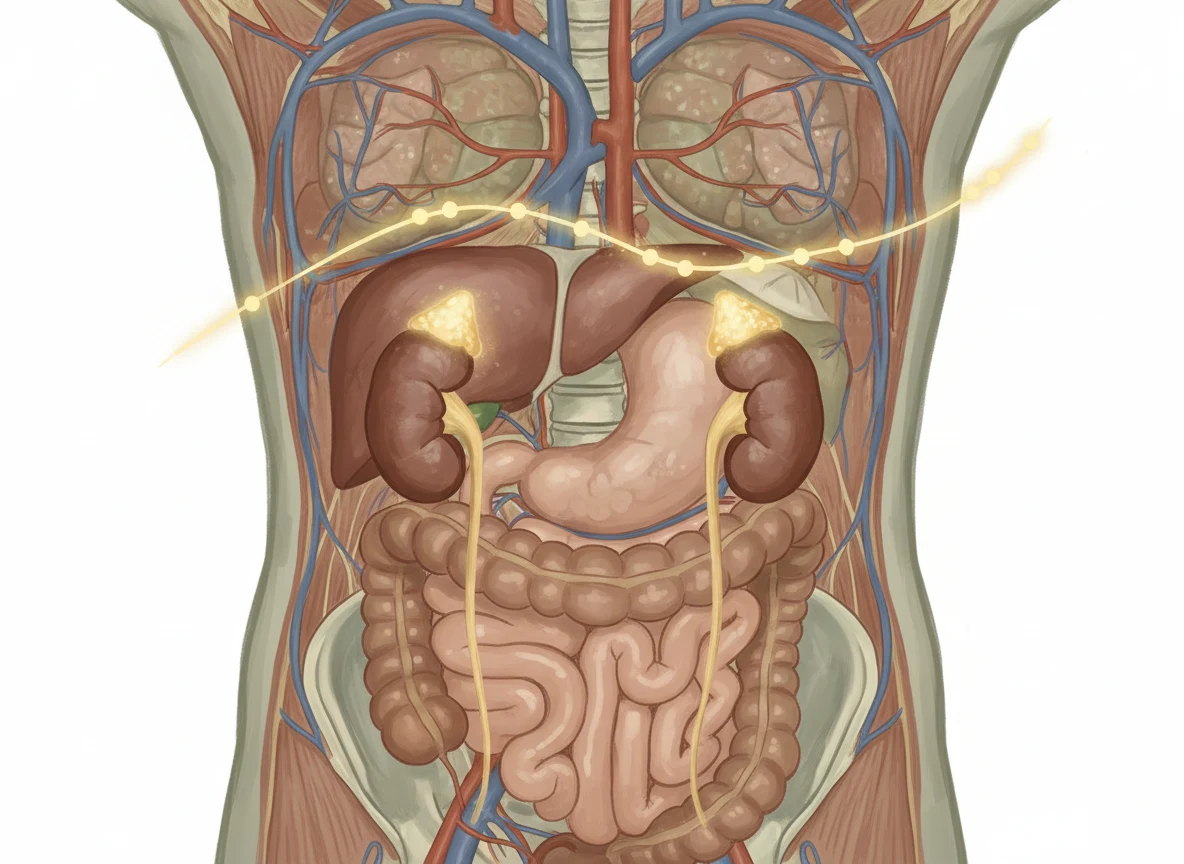
Your adrenal glands — two small structures sitting above your kidneys — produce cortisol every day through a feedback loop called the HPA axis: hypothalamic-pituitary-adrenal. That name sounds imposing, but the function is straightforward: cortisol regulates blood sugar, modulates your immune system, manages inflammation, and helps your body access stored energy when it needs to.
The daily pattern is tight and predictable. Levels sit lowest around midnight. Before you even open your eyes, they begin climbing — reaching their peak roughly 30 to 45 minutes after waking in what researchers call the cortisol awakening response, which was the subject of a major 2025 review in Endocrine Reviews. By evening, levels fall back again. High in the morning, low at night: that diurnal curve is the signature of a healthy system.
Think of the cortisol awakening response as your body running its morning diagnostic — a controlled surge that has nothing to do with anxiety or overwork. That peak is not a warning sign. It is your physiology preparing you for the day.
“Adrenal Fatigue”: What the Research Actually Found
The wellness narrative is coherent on its face. Modern life is stressful; the adrenal glands eventually exhaust themselves; they stop producing enough cortisol; that is why you feel wiped out, foggy, and flat. This is the story sold as “adrenal fatigue.”
A 2016 systematic review published in BMC Endocrine Disorders examined 58 studies and found no scientific evidence that adrenal fatigue exists as a medical condition. No major endocrinology society in the world recognises it. No validated diagnostic criteria exist for it.
This doesn’t mean burnout, exhaustion, or the effects of chronic psychological stress aren’t real — they plainly are. The question is whether “adrenal fatigue” accurately describes what’s happening in the body. The evidence says it doesn’t.
Why Home Cortisol Tests Can’t Tell You Much
The consumer cortisol market — saliva kits, urine strips, wearable “stress trackers” — has grown alongside the adrenal fatigue narrative. Here’s the distinction that matters: cortisol is not a static number. A healthy person’s levels can differ by a factor of three or four between morning and evening. A single saliva swab at one point in the day tells you almost nothing meaningful about whether your cortisol profile is actually out of range.
Diagnosing a genuine cortisol disorder requires multiple timed samples in a clinical setting, with reference ranges that are properly validated. Consumer kit reference values remain poorly standardised, as a 2024 systematic review in Psychophysiology noted when examining immunoassay-based hair and salivary cortisol measurement in healthy adults.
A test that can’t reliably tell you whether your result is normal isn’t a health tool. It’s a marketing tool.
”Cortisol Face” Is Real — But Not Because of Stress
The rounded face, central weight gain, fatty deposits at the back of the neck — these are genuine clinical signs. They are features of Cushing’s syndrome: a condition caused by pathologically elevated cortisol, at levels far above anything that ordinary life stress produces.
As Associate Professor Craig Doig of Nottingham Trent University wrote in The Conversation in 2025, the cortisol generated by everyday stress “doesn’t even come close to the levels or duration” required to produce those effects. Cushing’s syndrome affects roughly two to three people per million each year. It requires specialist diagnosis — not a supplement.
Here’s the distinction that matters: the wellness industry borrowed the symptom language from a genuine, rare endocrine disorder and applied it to everyone who has ever felt tired and stressed. That is not science. It is a sales tactic.

What Actually Disrupts Cortisol — and What Genuinely Helps
The levers that have real evidence behind them are, in practice, unglamorous.
Sleep is the most powerful. Cortisol’s daily rhythm is anchored to your circadian system. Chronic sleep deprivation flattens the diurnal slope — levels stop falling as they should overnight — which undermines the cleanly calibrated morning peak that supports energy and focus.
Regular moderate exercise supports healthy HPA axis function over time. A hard session will raise cortisol short-term, and that’s normal — it’s part of the adaptive response, not a problem to suppress. The long-term picture is what matters, and it is generally positive.
Mindfulness-based stress reduction has more evidence than many people realise. A 2016 meta-analysis of five randomised controlled trials in Frontiers in Physiology found a statistically significant reduction in salivary cortisol in healthy adults who practised it. The effect was modest — not a cure — but it was real and consistent across studies.
One further thing worth naming, if only because it’s ironic: the social media platforms amplifying cortisol anxiety are themselves a meaningful source of it. Spending less time on them may be among the most practical steps available.
What “Cortisol Products” Can’t Do
Before spending money on cortisol-lowering supplements, it helps to be clear about what they cannot do:
- They cannot treat Cushing’s syndrome, which requires specialist medical care.
- They cannot compensate for chronic sleep deprivation or sustained psychological stress.
- None have been shown to reliably normalise cortisol levels in healthy adults in well-designed clinical trials.
- Products marketed as “cortisol blockers” may affect other hormonal and metabolic pathways in ways that haven’t been adequately studied.
The Bottom Line on Cortisol
Cortisol is a tightly regulated, essential hormone doing exactly what it was designed to do. The industry built around “fixing” it has borrowed the language of a genuine — and genuinely rare — medical condition, attached it to vague everyday symptoms, and packaged it with tests that cannot meaningfully interpret their own results.
Neither adrenal fatigue nor “cortisol face” applies to the vast majority of people who’ve been told they fit the description. If you’re genuinely concerned about your cortisol levels, a GP can order the appropriate timed tests and refer you to an endocrinologist if something looks off. If you’re dealing with the effects of chronic stress, the evidence points toward sleep, regular movement, and — where it’s accessible — mindfulness-based programmes. Nothing in the supplement aisle comes close to those three.
Frequently Asked Questions
Can high cortisol actually cause weight gain? At pathologically high levels — the kind seen in Cushing’s syndrome — yes, chronically elevated cortisol does cause central weight gain and characteristic fat redistribution. But the cortisol produced in response to everyday stress doesn’t reach those levels; the two aren’t the same thing. Conflating them is precisely what wellness marketing relies on.
Are there any supplements that lower cortisol? Some compounds, including ashwagandha and phosphatidylserine, have shown modest effects on cortisol in small studies under specific conditions. But the evidence base is limited, effect sizes are generally small, and long-term safety in healthy adults hasn’t been well characterised. They’re not a substitute for sleep, exercise, or stress management — the interventions with the strongest evidence.
Should I get my cortisol tested? If you have symptoms that genuinely concern you — unexplained central weight gain, easy bruising, unusual skin changes, or hard-to-control blood pressure — see your GP. The appropriate tests (multiple timed salivary samples, 24-hour urinary free cortisol, or a dexamethasone suppression test) are done in a clinical setting. Home saliva tests at a single time point can’t give you a meaningful answer.
References
- Global Wellness Institute (2025) — The Global Wellness Economy Hits a Record $6.8 Trillion and Is Forecast to Reach $9.8 Trillion by 2029. PR Newswire. https://www.prnewswire.com/news-releases/the-global-wellness-economy-hits-a-record-6-8-trillion-and-is-forecast-to-reach-9-8-trillion-by-2029—302615214.html
- Cadegiani FA & Kater CE (2016) — Adrenal fatigue does not exist: a systematic review. BMC Endocrine Disorders, 16:48. DOI: 10.1186/s12902-016-0128-4. https://pmc.ncbi.nlm.nih.gov/articles/PMC4997656/
- Stalder T, Oster H, Abelson JL et al. (2025) — The Cortisol Awakening Response: Regulation and Functional Significance. Endocrine Reviews, 46(1):43–59. DOI: 10.1210/endrev/bnae024. https://academic.oup.com/edrv/article/46/1/43/7739741
- Steffensen C, Bak AM, Rubeck KZ, Jørgensen JOL (2010) — Epidemiology of Cushing’s Syndrome. Neuroendocrinology, 92(Suppl 1):1–5. https://karger.com/nen/article/92/Suppl.%201/1/226720/Epidemiology-of-Cushing-s-Syndrome
- Doig C (2025) — Why you don’t need to stress about cortisol ruining your waistline – or your face. The Conversation, 26 April 2025. https://theconversation.com/why-you-dont-need-to-stress-about-cortisol-ruining-your-waistline-or-your-face-254335
- Sanada K, Montero-Marin J, Alda Díez M et al. (2016) — Effects of Mindfulness-Based Interventions on Salivary Cortisol in Healthy Adults: A Meta-Analytical Review. Frontiers in Physiology, 7:471. https://www.ncbi.nlm.nih.gov/pmc/articles/PMC5069287/
- Igboanugo M et al. (2024) — A systematic review of hair cortisol in healthy adults measured using immunoassays: Methodological considerations and proposed reference values for research. Psychophysiology. https://pubmed.ncbi.nlm.nih.gov/37950380/
- Nieman LK, Biller BMK, Findling JW et al. (2008) — The Diagnosis of Cushing’s Syndrome: An Endocrine Society Clinical Practice Guideline. Journal of Clinical Endocrinology & Metabolism. https://pmc.ncbi.nlm.nih.gov/articles/PMC2386281/